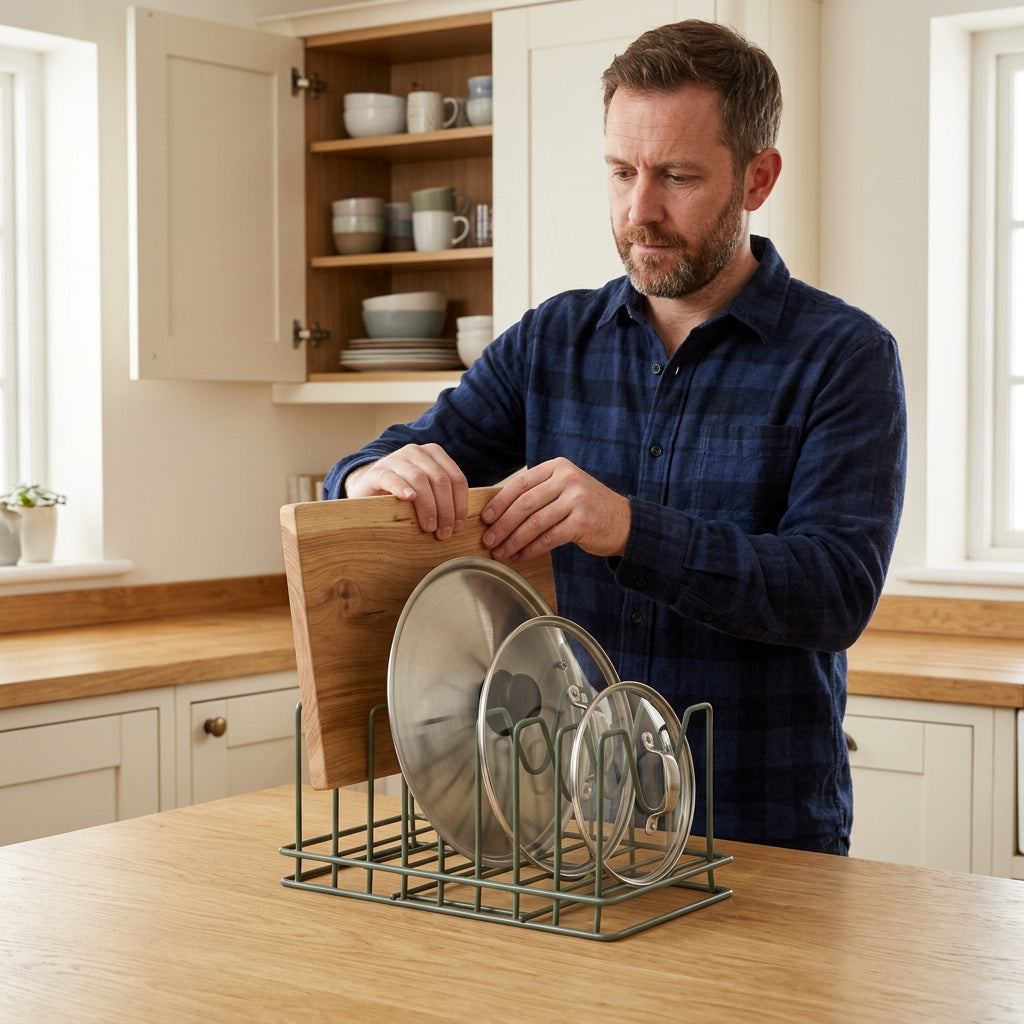
Adjustable Pot-Lid and Cutting-Board Rack
Adjustable Pot-Lid and Cutting-Board Rack
📢Try it now and if it doesn't work, we guarantee a full refund!
✅ Made in the UK
✅ 90-day money-back guarantee
✅ Natural ingredients for fast, long-lasting results
✅ Long-standing service to the London Early Years Foundation
⚡ Stock is limited and will sell out soon!
Couldn't load pickup availability
🍳 Stop searching through stacked kitchenware
Stacked lids and boards can turn a simple cooking task into a search through a crowded cupboard.
When lids and cutting boards are stacked together, the piece you need often seems to be underneath something else. An adjustable rack offers a more deliberate way to arrange compatible pieces upright. Start by choosing the kitchenware that earns its space through regular use. Keeping the collection focused can be more useful than trying to fit every spare lid and board into the same corner.

🥘 Give lids and boards a visible home
Why this approach. Separated positions help distinguish one piece from the next and support a consistent place to return it after cleaning. Adjust the layout only within the rack's actual design, considering the shape of handles and the thickness of boards. A good arrangement keeps each item supported without letting neighboring pieces press awkwardly together. The aim is accessible storage, not an unstable display of as many items as possible.
Prepare the area. Lay out the lids and boards you want to store and look at their shapes. A wide lid handle can need more room than the rim suggests, while a tall board needs enough clearance above it to be lifted out. Remove pieces you rarely use from the daily arrangement if they make access awkward. Check that the supporting surface is level and that the rack cannot easily be knocked while you work nearby.

🪵 Settle each piece into its place
Practical use. Choose a level position with room above and around the rack. Compare the available space with both the rack and the items you intend to store. Follow the adjustment instructions, then place kitchenware into the arrangement gradually. Check that each piece sits securely and can be removed without tipping another. If it is inside a cupboard, test the door and any moving shelf before settling on the layout.
Check compatibility. Check rack dimensions, separator positions, item thickness, and the available cupboard or counter space. Consider the surrounding space as well as the immediate contact area: you need room for your hands, for the task itself, and for anything that must move or be removed afterward. Keep the supplied instructions with your household care information so you can refer back to them. If the setup changes, check it again rather than assuming the same arrangement will still be appropriate.

🌿 Return kitchenware thoughtfully
Return a piece to its chosen position only when it is ready for storage. If retrieving one item repeatedly disturbs another, pause and adjust the arrangement rather than balancing it more carefully each time. Keep the kitchenware you reach for most in the easiest positions. Reassess the rack when you add a new board or replace a pan, because a change in shape can matter as much as a change in size.

🫧 Keep everyday kitchen storage considered
Care and storage. Return only kitchenware that has been cleaned and dried according to its own instructions. Remove the contents before cleaning the rack, using a method suitable for its finish. Check contact points for trapped debris or wear. Dry the area before replacing everything, and avoid leaving damp boards resting in a crowded arrangement where their normal care requirements cannot be followed.
Before next time. Before the next use, take a moment to look over the parts you will handle and the area where they will be used. Stop if something is damaged, loose, or no longer suitable for the task. Store the product where it can be retrieved without disturbing fragile items, and keep any loose components together according to the supplied guidance. A thoughtful finish today makes the next household task easier to begin.

💬 Rack questions
Will all pot lids fit?
Lid diameter, handles, rim shape, and rack spacing all matter. Compare the actual pieces with the rack before arranging them.
Can it hold cutting boards of different thicknesses?
Use the permitted adjustment positions and check that each board is supported securely. Do not force a board into a gap.
Should heavier pieces go at one end?
Follow the product's loading guidance and keep the overall arrangement stable. Avoid a top-heavy setup or unsupported kitchenware.
Can I place it beside the cooker?
Choose a suitable location away from heat and splash exposure that the product's material guidance does not allow.

Adjustable Pot-Lid and Cutting-Board Rack